I Quit Short-Form Content for 80 Hours. Here's What Happened.
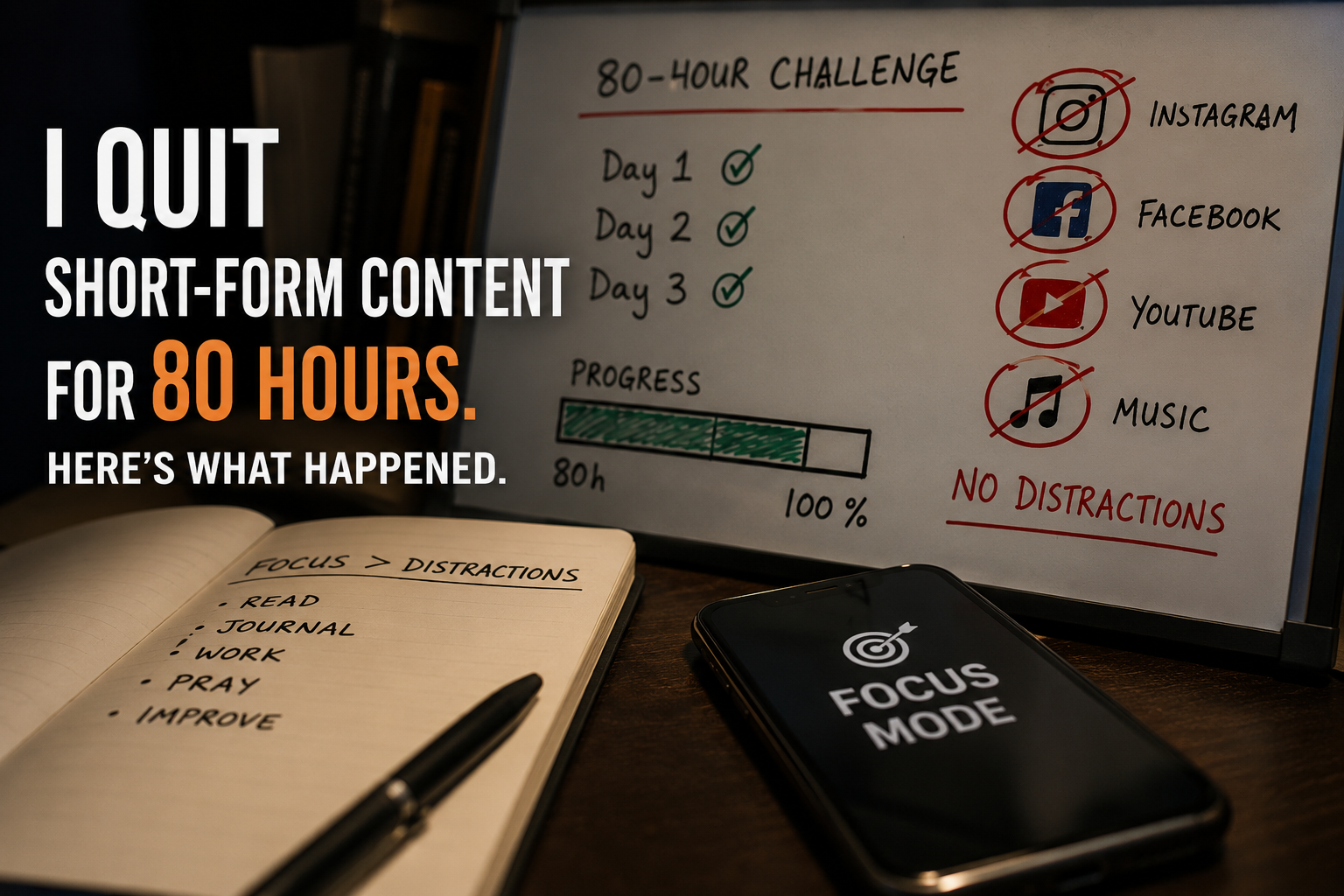
Three days without Instagram Reels, Facebook Reels, YouTube Shorts, or TikTok doesn't sound impressive. It isn't. I know 80 hours won't magically rebuild years of shortened attention spans. That wasn't the goal.
This challenge was simply an experiment.
I wanted to see what would happen if I removed short-form content from my daily life for a few days. Would I become more focused? More creative? More patient? Or would nothing change at all?
Here's what happened.
Why I Started
For months, I noticed something changing.
I got bored much faster than I used to.
Routine became frustrating. Reading became harder. Journaling felt like something I had to force myself to do. Even sitting down to think deeply about an idea became uncomfortable.
At first, I blamed laziness.
Then I started wondering if my attention span had simply become used to constant stimulation.
So instead of complaining about it, I decided to run a small experiment.
The challenge wasn't about becoming productive overnight.
It was about rebuilding my ability to sit with boredom.
I also wanted to improve my patience, make reading easier, enjoy journaling again, and train my sense of time instead of constantly looking for the next distraction.
The Rules
The challenge was simple.
For 80 hours, I avoided:
- Instagram Reels
- Facebook Reels
- YouTube Shorts
- TikTok
I still allowed myself to:
- Watch movies, anime, or TV shows—but only at the end of the day while relaxing.
- Check notifications.
- Use my phone and PC for work.
- Play games in moderation. During the challenge I only played a little Rocket League and Medal of Honor: Allied Assault during my day off, purely for fun rather than competition.
The goal wasn't to eliminate entertainment.
The goal was to eliminate constant, instant stimulation.
The First Thing I Noticed
I expected to miss social media.
Instead, I missed having something to fill every tiny gap in my day.
Whenever I finished a task at work, my brain immediately searched for something to replace it.
Those five-minute gaps suddenly felt much longer.
Instead of scrolling, I had to actually find something meaningful to do.
Sometimes that meant journaling.
Sometimes reading.
Sometimes simply walking around, talking to coworkers, or finding another task to work on.
It sounds small, but those tiny moments added up throughout the day.
An Unexpected Personal Milestone
During the challenge, I also had something important to do outside of work.
I spent time visiting several banks to open my youth account and connect it to PayPal.
For a lot of people that's a normal errand.
For me, it wasn't.
I've always been nervous about social interactions, especially when I have to ask questions or deal with unfamiliar situations.
But I reminded myself why I started working in the first place.
I'm not just earning money.
I'm also trying to improve my communication skills, become more confident, and get comfortable handling real responsibilities.
Walking into those banks and dealing with everything myself felt like a personal victory.
Something Unexpected Happened at Work
One day during the challenge, I discovered a way AI could help us complete one of our tasks faster.
I showed it to several coworkers, and it ended up saving time.
Maybe that would've happened anyway.
Maybe it was just a coincidence.
But it reminded me that when my brain wasn't constantly looking for another 15-second video, I seemed more aware of opportunities around me.
The Hardest Part
The hardest part wasn't resisting social media.
It was resisting the habit.
Whenever I had nothing to do for a few minutes, my hand almost reached for my phone automatically.
I wasn't even thinking about watching Reels.
It had simply become a reflex.
That was probably the biggest lesson of the challenge.
The apps weren't controlling me.
The habit was.
What Surprised Me
A few things surprised me.
First, I developed headaches near the end of each day.
Maybe it was because I spend most of my workday using computers.
Maybe it was because I still played games occasionally.
Or maybe my brain was simply adjusting.
I honestly don't know.
The second surprise was much more positive.
Once I removed short-form content, I became surprisingly good at filling empty moments with useful things.
Instead of immediately reaching for my phone, I found myself journaling, reading, walking around, talking to coworkers, or simply thinking.
Those moments stopped feeling like wasted time.
What Changed
I'm not going to pretend that three days changed my life.
They didn't.
But they did change a few things.
I became better at putting my phone down instead of endlessly opening one app after another.
I felt more comfortable with boredom.
I felt more confident—not because I quit Reels, but because I kept a promise I made to myself.
Even if the improvement was small, that's still progress.
And if this experiment helps reduce the amount of short-form content I consume over the long term, then it was worth it.
Would I Recommend It?
Yes.
But don't expect three days to completely transform your life.
Expect three days to reveal habits you didn't know you had.
For me, the biggest discovery wasn't that I stopped watching Reels.
It was realizing how often my brain expected entertainment the moment I had nothing to do.
That's the habit I'm trying to change.
Final Thoughts
I don't think short-form content is evil.
But I do think it's incredibly easy to lose hours without realizing it.
During those hours, your brain rarely gets the chance to stay with one idea long enough to solve a problem, reflect on your day, or create something meaningful.
Reading feels slower.
Journaling feels slower.
Thinking feels slower.
But maybe that's exactly what our minds need sometimes.
This wasn't the end of the experiment.
It was just the beginning.
No comments yet. Be the first to share your thoughts!
Failed to load comments.